

Primary care is the most common setting where depression is first identified and treated in the United States. Your family doctor does far more than check blood pressure and order lab work. Primary care providers screen for depression, manage medications, coordinate behavioral health support, and track your progress over time. This integrated approach, often called collaborative care or measurement-based care in clinical literature, makes primary care a practical and effective first line of treatment for most people experiencing depression.
Why primary care treats depression: the screening foundation
Depression screening in primary care is not optional or informal. The U.S. Preventive Services Task Force issued a Grade B recommendation in 2026 for depression screening in all adults aged 19 and older. This recommendation covers people without a prior diagnosis, people who show no obvious symptoms, pregnant women, postpartum women, and older adults. That breadth matters because depression frequently goes undetected until it becomes severe.
The standard tool used in primary care is the PHQ-9, a nine-question validated questionnaire that takes about three minutes to complete. A score guides the clinician toward watchful waiting, brief counseling, medication, or a referral. This happens during a routine visit, which means detection does not require a separate appointment with a mental health specialist.
Early detection in primary care allows timely intervention before depression worsens. Screening in primary care is about identifying risk early and connecting patients to appropriate treatment pathways, not replacing psychiatry in complex cases. The key benefit is access: your primary care provider sees you regularly, knows your health history, and can act immediately.
Key screening facts at a glance:
- The PHQ-9 is the most widely used validated screening tool in primary care
- Screening applies to adults 19 and older, including pregnant and postpartum patients
- Patients without any prior mental health diagnosis are included in screening recommendations
- A positive screen leads to a structured follow-up plan, not just a referral slip
What is collaborative care and why does it work?
Collaborative care is the evidence-based model that defines how primary care handles depression at its best. It brings together three roles: a primary care clinician, a care manager (often a nurse or social worker), and a consulting mental health specialist. The care manager tracks your symptoms between visits, supports medication adherence, and flags when your treatment plan needs adjustment.

A meta-analysis published in Consultant360 found that collaborative care reduces depression severity significantly at four to six months, with benefits lasting up to 24 months. The standardized mean difference was −0.20, and therapeutic strategy contributed an effect size of −0.07 with P less than .001. These are clinically meaningful improvements, not marginal gains.
The model works because it removes the gap between detection and treatment. Instead of waiting weeks for a psychiatry appointment, you begin care within your existing primary care relationship. Family involvement and patient-centered goal-setting are built into the process.
"Measurement-based care, where PHQ-9 scores are tracked at every visit, allows clinicians to adjust treatment based on real data rather than impressions. This is the same logic applied to managing blood pressure or diabetes, and it works just as well for depression."
The steps in a collaborative care plan typically follow this sequence:
- Initial screening and risk assessment during a routine visit
- Care manager contact to establish goals and explain the treatment plan
- Medication initiation or psychotherapy referral based on severity
- Regular PHQ-9 follow-up to track response
- Consulting psychiatrist review if symptoms do not improve within four to six weeks
- Continued primary care follow-up for relapse prevention after stabilization
How brief psychotherapy fits into primary care treatment
Many people assume therapy requires months of weekly sessions. That assumption keeps people from starting. The VA's evidence synthesis program found that brief psychotherapies of 6 to 8 sessions of cognitive behavioral therapy (CBT) or problem-solving therapy are both effective and feasible in primary care settings, with a number needed to treat of approximately 5 to 8. That means for every five to eight people who complete a brief course, one achieves remission who would not have otherwise.
These therapies can be delivered by nurses, social workers, and trained counselors within the primary care clinic. Sessions can happen by phone or video, which removes transportation and scheduling barriers. This flexibility makes brief psychotherapy a realistic option even for patients with demanding schedules or limited mobility.
| Therapy type | Session count | Who delivers it | Format options |
|---|---|---|---|
| Brief CBT | 6 to 8 sessions | Psychologist, social worker, nurse | In-person, phone, video |
| Problem-solving therapy | 6 to 8 sessions | Social worker, trained counselor | In-person, phone |
| Behavioral activation | 4 to 8 sessions | Nurse, counselor | In-person, video |
Psychotherapy in primary care functions as either a first-line treatment for mild to moderate depression or as an adjunct to antidepressant medication for more severe cases. The two approaches are not competing. Many patients benefit most from both.
Pro Tip: If your primary care provider offers a referral to a behavioral health counselor within the same clinic, accept it. Same-clinic referrals have significantly higher follow-through rates than referrals to external mental health providers.
Why primary care is well-suited to manage depression with physical health conditions
Depression rarely exists in isolation. It frequently co-occurs with diabetes, heart disease, chronic pain, and thyroid disorders. Primary care clinicians are trained to assess whether depressive symptoms stem from a medical condition, a medication side effect, or a primary mood disorder. This distinction changes the treatment plan entirely.
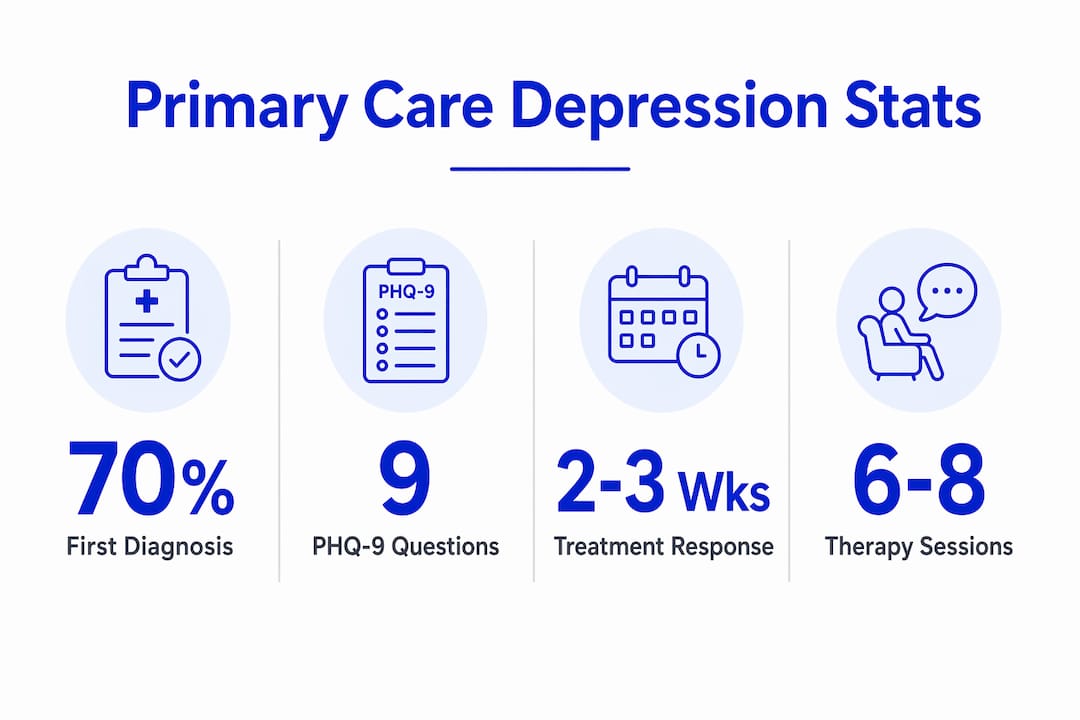
According to the Merck Manual, antidepressant response typically appears within two to three weeks, and treatment continues for six months or longer depending on the number of prior episodes and symptom severity. Primary care providers manage this timeline with the same structured follow-up used for chronic disease management. They adjust doses, monitor for side effects, and rule out medical causes of persistent symptoms.
A JAMA trial called PETRUSHKA demonstrated that measurement-based depression care in primary care significantly improved PHQ-9 scores over 24 weeks. Patients receiving personalized decision support were more likely to remain on antidepressants at eight weeks, with a discontinuation rate of 17 percent compared to 27 percent in usual care. Staying on medication long enough for it to work is one of the biggest challenges in depression treatment, and primary care's ongoing relationship with patients directly addresses that problem.
Pro Tip: Tell your primary care provider about every medication you take, including supplements. Some combinations affect how antidepressants work or increase side effect risk. Your family doctor's knowledge of your full medical picture is one of the strongest advantages of chronic disease management in primary care.
How embedded behavioral health and referral pathways work
Not every primary care clinic has a psychiatrist on staff, but many now include embedded behavioral health consultants. These are licensed mental health professionals who work within the primary care setting and see patients during or immediately after their medical visit. According to Health.mil, these consultants typically see patients in sessions lasting no more than 30 minutes over one to two visits, providing focused, evidence-based interventions that initiate care quickly.
The most effective handoff to specialty mental health happens within the same clinic visit flow. When a patient screens positive for depression and a behavioral health consultant is available that same day, the likelihood of follow-through increases substantially. This model reduces the referral gap that causes many patients to fall out of care entirely.
Here is how the referral pathway typically works in a well-organized primary care setting:
- Positive PHQ-9 screen triggers same-day or next-visit behavioral health consultation
- Behavioral health consultant completes a focused assessment and initiates brief intervention
- Primary care clinician and consultant coordinate on medication decisions if needed
- Patients who do not respond after four to six weeks are referred to specialty psychiatry or psychology
- Primary care continues follow-up after specialty care to support relapse prevention and medication continuity
- Behavioral health services remain accessible within the primary care relationship throughout the process
This structure means you do not have to choose between your family doctor and a mental health provider. Both work together within a system designed to keep you supported.
Key takeaways
Primary care treats depression because it combines early detection, continuous follow-up, medication management, and behavioral health support within a single, accessible care relationship.
| Point | Details |
|---|---|
| Screening is universal | USPSTF 2026 recommends depression screening for all adults 19 and older, including pregnant and postpartum patients. |
| Collaborative care works | Meta-analysis shows collaborative care reduces depression severity with benefits lasting up to 24 months. |
| Brief therapy is effective | Six to eight sessions of CBT or problem-solving therapy achieve meaningful outcomes in primary care settings. |
| Medication needs active follow-up | Antidepressant response takes two to three weeks; primary care manages dosing and adherence over six or more months. |
| Embedded behavioral health reduces gaps | Same-clinic behavioral health consultants improve follow-through and reduce the referral dropout problem. |
What I have seen working in primary care mental health
From my perspective, the single most underappreciated advantage of treating depression in primary care is the existing relationship between patient and provider. People are far more likely to disclose depressive symptoms to a doctor they have seen for years than to a stranger in a specialty clinic. That trust is not a soft benefit. It is a clinical asset that directly affects whether someone starts treatment and stays with it.
The collaborative care model represents the clearest evidence-based path forward, but it requires clinics to invest in care managers and measurement systems. Practices that use repeated PHQ-9 tracking treat depression the way they treat hypertension: with data, dose adjustments, and scheduled follow-up. That discipline produces better outcomes than a single visit and a prescription.
I also think the stigma around mental health treatment is meaningfully reduced when care happens in a primary care setting. Walking into your family doctor's office feels different from walking into a psychiatric clinic. For many patients, that difference determines whether they seek help at all. Primary care's role in mental and behavioral health is not a workaround. It is the right model for the majority of people with mild to moderate depression, with clear escalation pathways for those who need more.
— Alessandro
Get compassionate depression care close to home
If you or someone you care about is dealing with depression, you do not have to figure it out alone. At Hmc-pc, our providers in the Port Huron area offer patient-centered care that addresses both your mental and physical health in one place. We use evidence-based screening, medication management, and behavioral health coordination to support you at every step.
Our family doctors in Fort Gratiot, MI are experienced in managing depression alongside chronic conditions, and we offer same-day appointments so you can get care when you need it most. Whether you are just starting to notice symptoms or have been struggling for a while, we are here to listen and create a plan that fits your life. Reach out to Hmc-pc today to schedule your visit.
FAQ
Can a primary care doctor diagnose depression?
Yes. Primary care doctors use validated tools like the PHQ-9 and clinical assessment to diagnose depression. The USPSTF recommends that all adults 19 and older be screened during routine primary care visits.
What treatments does primary care offer for depression?
Primary care providers offer antidepressant medication management, brief psychotherapy referrals, and behavioral health consultations. Many clinics also use collaborative care models that include care managers and consulting psychiatrists.
How long does depression treatment take in primary care?
Antidepressant response typically appears within two to three weeks, and treatment usually continues for six months or longer. Brief psychotherapy courses run six to eight sessions.
When does primary care refer to a psychiatrist?
Primary care refers to specialty psychiatry when patients do not respond to initial treatment after four to six weeks, or when the case involves complex diagnoses, significant safety concerns, or the need for longer-term intensive therapy.
Is therapy available through primary care?
Yes. Many primary care clinics include embedded behavioral health consultants who provide brief evidence-based therapy in short visits. Sessions can also be delivered by phone or video for added convenience.