

Combining therapy and primary care means embedding behavioral health services directly into your routine medical visits so that mental and physical health are treated together, not in separate silos. This model, formally called Integrated Behavioral Health (IBH), is the recognized clinical standard for coordinated therapy and healthcare. At Hmc-pc, we see every day how patients benefit when their counselor and their family doctor share the same team, the same records, and the same goals. This article explains how the IBH model works, what to expect at each step, and how you can advocate for this kind of care for yourself and your family.
How to combine therapy and primary care: what you need to know first
Before you can benefit from an integrated therapy approach, both you and your care team need a few things in place. The foundation is a primary care team that has been expanded to include behavioral health professionals, typically licensed clinical social workers, psychologists, or counselors who work inside the clinic rather than at a separate location. This structure is what separates true integration from a simple referral to an outside therapist.
On the clinical side, the process starts with screening. Your primary care provider uses validated tools such as the PHQ-9 for depression or the GAD-7 for anxiety to identify mental health needs during a routine visit. From there, a triage workflow routes you to the appropriate level of support, whether that is a brief in-clinic session, a warm handoff to an on-site counselor, or a referral to specialty mental health care. Integrated Behavioral Health is described as an ongoing process that includes screening, brief visits, and a bridge to specialty care when needed.
The table below summarizes the key prerequisites for successful integration from both the patient and provider perspective.
| Prerequisite | Details |
|---|---|
| Behavioral health staff on-site | Licensed social workers, psychologists, or counselors embedded in the primary care clinic |
| Validated screening tools | PHQ-9, GAD-7, or AUDIT administered at intake or annual wellness visits |
| Shared communication systems | Coordinated scheduling and joint documentation between medical and behavioral health staff |
| Insurance and billing alignment | Verification that behavioral health visits are covered under your primary care plan or Medicare |
| Warm handoff protocol | A defined workflow for introducing patients to behavioral health providers during the same visit |
Insurance is a practical concern worth addressing early. Many plans cover behavioral health visits billed under primary care, but coverage varies. If you are on Medicare, behavioral health coverage under primary care plans has expanded in recent years, making integration more financially accessible for older adults.
How does the integrated therapy approach work within primary care clinics?
The patient experience in an integrated clinic follows a clear sequence. Understanding each step helps you know what to expect and how to prepare.
- Screening at check-in. You complete a brief mental health questionnaire, often on a tablet or paper form, before seeing your doctor.
- Provider review. Your primary care provider reviews your responses and flags any concerns during the medical visit.
- Warm handoff introduction. If a concern is identified, your doctor walks you to the on-site behavioral health provider or brings that provider into the exam room to introduce you directly.
- Brief focused visit. The behavioral health provider conducts a short session, typically 15 to 30 minutes, to assess your needs and begin support.
- Care plan coordination. Your doctor and the behavioral health provider share notes and align on a treatment plan before you leave.
- Follow-up scheduling. You leave with a scheduled follow-up appointment, either for continued brief therapy in the clinic or a referral to a specialty provider if needed.
The warm handoff step is the most critical. Warm handoffs double or triple referral uptake compared to paper or cold referrals. That statistic reflects a simple truth: when a trusted doctor personally introduces you to a counselor, you are far more likely to follow through than if you are handed a phone number and left to make the call yourself.
On the provider side, behavioral health providers in integrated clinics spend 56% of their time on direct patient care, 29% on administrative tasks, and 15% on team consultation. That 15% team consultation time is where the real coordination happens. It means your counselor and your doctor are actively discussing your case, not operating independently.
A real-world example: UNC Health launched a same-day mental health program in 2026 where a licensed clinical social worker is available during primary care visits. The program recorded over 70 warm handoff encounters and served 125 patients since implementation. That scale of reach, from a single embedded clinician, shows how much access improves when therapy comes to the patient rather than the other way around.
Pro Tip: Call your clinic before your appointment and ask directly: "Do you have a behavioral health provider on-site, and do you offer warm handoffs?" If the answer is yes, ask that it be noted in your chart so the care team is prepared.
What models exist to combine mental health services, and how do they compare?
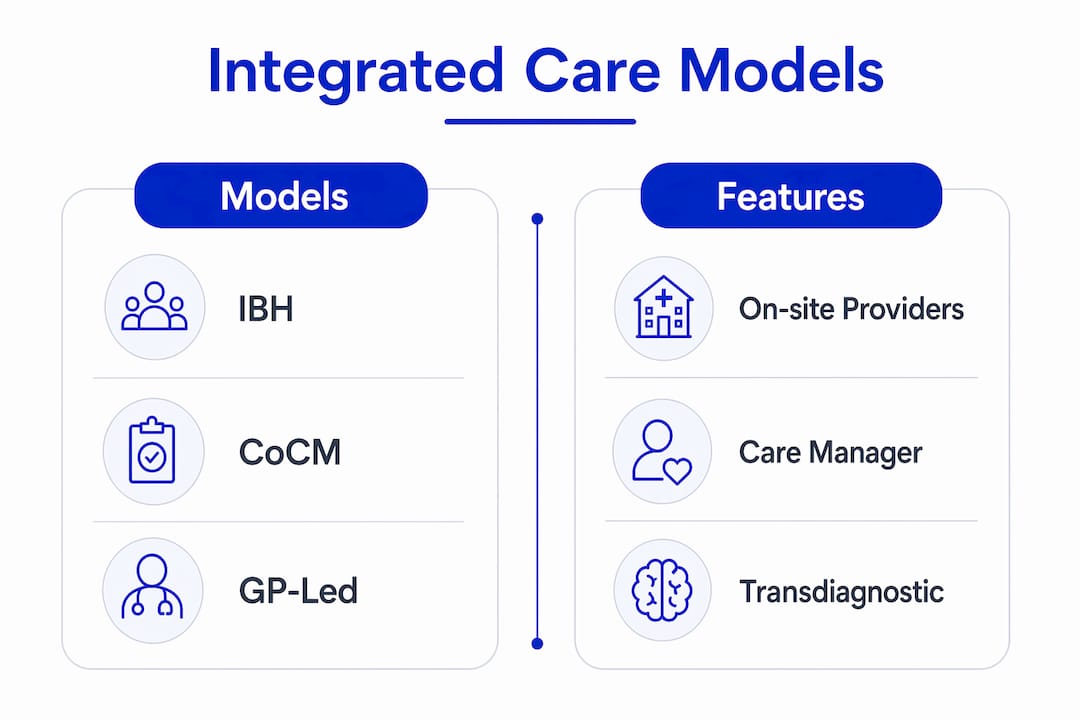
Not every clinic uses the same structure. Three models are most common in the United States, and they differ significantly in how much coordination actually happens between your medical and mental health care.
The Integrated Behavioral Health (IBH) model places behavioral health providers inside the primary care clinic as full team members. Visits are brief and focused, and the warm handoff is standard practice. IBH implementation requires coherence across the team and reflexive monitoring, meaning the clinic continuously evaluates and adjusts how integration is working.

The Collaborative Care Model (CoCM) uses a care manager, typically a social worker or nurse, who coordinates between your primary care provider and a consulting psychiatrist. You may never see the psychiatrist in person. Instead, your care manager tracks your progress and adjusts your treatment plan based on psychiatric input. This model works well for depression and anxiety at scale and has strong evidence behind it.
A third approach, tested in a 2026 cluster RCT in Germany, uses GP-led transdiagnostic mental health interventions. General practitioners deliver four structured 20-minute sessions covering psychoeducation and cognitive flexibility directly during primary care appointments. This model requires no additional behavioral health staff, making it practical for under-resourced clinics.
| Model | Who delivers therapy | Visit format | Warm handoff | Best for |
|---|---|---|---|---|
| Integrated Behavioral Health (IBH) | On-site behavioral health provider | Brief, same-day visits | Yes, standard | Patients needing immediate access and team-based care |
| Collaborative Care Model (CoCM) | Care manager plus consulting psychiatrist | Ongoing care management | Partial | Depression and anxiety at population scale |
| GP-led transdiagnostic intervention | Primary care physician | Four structured 20-minute sessions | Not applicable | Clinics without dedicated behavioral health staff |
| Referral-only model | External therapist | Separate appointments | No | Patients with stable, non-urgent mental health needs |
The referral-only model, where your doctor gives you a name and you schedule separately, is still the most common. It is also the least effective for patients who are already overwhelmed. Fragmented care means repeated storytelling, scheduling gaps, and a higher chance of falling through the cracks. Patients in true IBH settings avoid repeated storytelling because their behavioral health provider is already part of the team and has access to shared records.
Common challenges when combining counseling and medicine
Even well-designed integrated programs face real obstacles. Knowing what they are helps you navigate them as a patient.
Barriers clinics commonly face:
- Multi-step referral delays that leave patients waiting weeks for mental health support after a primary care visit
- Administrative workload from dual documentation requirements for medical and behavioral health billing
- Insurance reimbursement gaps, particularly for brief behavioral health visits billed on the same day as a medical visit
- Staff resistance when behavioral health integration is treated as an add-on rather than a core clinical function
What patients can do:
- Ask specifically about warm handoffs and same-day behavioral health availability when choosing a primary care provider
- Confirm that your insurance covers same-day medical and behavioral health billing, sometimes called "incident to" billing
- Request that your primary care provider and your therapist share notes, even if they are at different locations
- If you are managing co-occurring mental health and substance use concerns, ask about integrated service pathways that address both conditions through a shared care plan rather than separate specialist clinics
The organizational side matters too. Clinics that treat IBH as a normalized part of practice, not a pilot program or a grant-funded experiment, sustain integration far better over time. Organizational culture embracing IBH as standard practice produces better implementation outcomes than clinics that view it as supplemental. That distinction matters when you are choosing where to receive care.
Pro Tip: When you call to schedule a primary care appointment, say: "I am looking for a provider who works closely with a behavioral health counselor on-site. Can you tell me how your clinic handles mental health concerns that come up during a visit?" The answer tells you immediately whether integration is real or just a brochure claim.
Key takeaways
Combining therapy and primary care through the Integrated Behavioral Health model produces better mental and physical health outcomes than referral-only care, and the warm handoff is the single most effective tool for making that integration work.
| Point | Details |
|---|---|
| IBH is the clinical standard | Integrated Behavioral Health places counselors inside primary care teams for same-day, coordinated visits. |
| Warm handoffs triple engagement | Patients introduced directly to a behavioral health provider are two to three times more likely to follow through with care. |
| Model choice affects your experience | IBH and Collaborative Care differ in access, staffing, and coordination. Ask which model your clinic uses. |
| Culture drives sustainability | Clinics that normalize behavioral health as routine practice sustain integration better than those treating it as optional. |
| Patients can advocate for themselves | Asking about warm handoffs and same-day behavioral health access is a practical step anyone can take before choosing a provider. |
What I have learned from watching integrated care work in practice
The most surprising thing about integrated care is not the clinical outcomes. It is the patient relief. When someone comes in for a blood pressure check and leaves having spoken with a counselor about the anxiety that is almost certainly driving that blood pressure up, something shifts. They did not have to make a second appointment. They did not have to explain their situation to a stranger in a different building. They were already there, already comfortable, and the conversation happened naturally.
What I have seen fail, repeatedly, is integration that exists on paper but not in practice. A clinic can hire a social worker and still have zero warm handoffs if the physicians do not change their workflow. The time distribution data tells the real story: 15% of a behavioral health provider's time goes to team consultation. That is not a lot. But if that 15% is not protected and structured, it disappears into administrative tasks and the team never actually coordinates.
My honest view is that patients should not wait for their clinic to figure this out. Ask the question directly. If your provider cannot tell you whether they have a warm handoff process, that is your answer. The clinics doing this well are proud of it and will tell you immediately. The ones that are not will fumble the response. Use that as a filter when choosing where to receive your care.
The future of primary care mental health is not a separate mental health department. It is a family doctor who knows your counselor by name, shares your chart, and can walk you down the hall when you need support. That model exists today. You just have to find it.
— Alessandro
How Hmc-pc supports integrated mental health and primary care
At Hmc-pc, we believe your mental health and your physical health belong in the same conversation. Our team at Health Management Care, PC in Port Huron, MI integrates behavioral health services directly into primary care visits, so you never have to choose between addressing a health concern and a mental health concern on the same day.

We offer same-day appointments and a care approach that connects your family doctor with behavioral health support from your very first visit. Whether you are managing chronic illness, stress, anxiety, or simply want a provider who sees the whole picture, our team is ready to help. Schedule a visit with a family doctor in Fort Gratiot and experience what coordinated, patient-centered care actually feels like.
FAQ
What does it mean to combine therapy and primary care?
Combining therapy and primary care means having a behavioral health provider, such as a licensed counselor or social worker, work as part of your primary care team so that mental health support is available during or immediately after your medical visit.
What is a warm handoff in primary care?
A warm handoff is when your primary care provider personally introduces you to an on-site behavioral health provider during your visit. Warm handoffs double or triple the rate at which patients follow through with mental health care compared to receiving a referral slip.
Can therapy improve primary care outcomes?
Yes. Addressing mental health within primary care reduces fragmentation, improves chronic disease management, and increases patient engagement. Programs like the UNC Health same-day mental health initiative demonstrate that embedded therapy access meaningfully expands the number of patients who receive timely support.
How do I know if my clinic offers integrated behavioral health?
Ask your clinic directly whether they have a behavioral health provider on-site and whether they use a warm handoff process. Clinics with true integration will answer that question clearly and confidently.
Does insurance cover same-day therapy during a primary care visit?
Many insurance plans, including Medicare, cover behavioral health visits billed alongside primary care on the same day. Confirm with your insurer and your clinic's billing team before your appointment to avoid unexpected costs.